
[Day 44] A Plea to Beihai
March · *The Woman Beneath the Moonlight* | about 3 min read
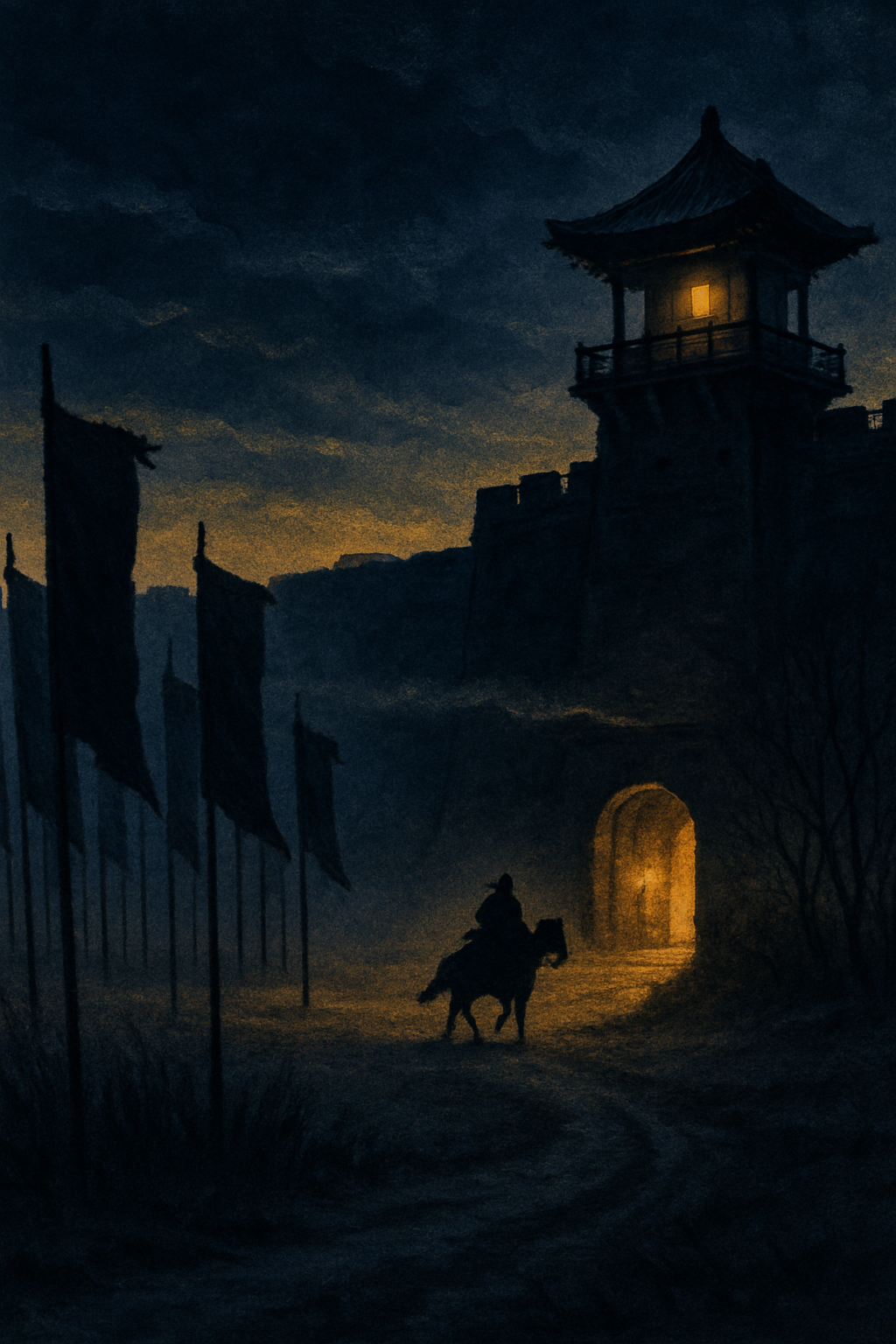
On the dawn when Cao Cao's great army planted its banners below the walls of Xuzhou, a letter was leaving one hand in Xuzhou, riding first toward the gate of Beihai (北海).
Inside the walls of Xuzhou, Tao Qian (陶謙) swallowed a great weeping. He summoned his officials urgently and took counsel. Cao Bao (曹豹) stepped forward low. "Lord Cao's power is great and his grudge is deep. Rather than fight, we had better submit." Tao Qian pondered long. He already knew that not a single life among the people could be saved by surrender before such an opponent. His eyes crossed to a corner of the seat.
In that corner, a man rose and bowed. He was of Juxian (朐縣) of Donghai (東海); his surname Mi (糜), his name Zhu (竺), his style Zizhong (子仲). His house had been a house of wealth for generations.
A year before, returning from a trade journey to Luoyang, a beautiful lady had asked to share his carriage. Mi Zhu stepped down, walked on foot, and yielded the carriage to her. After some li, the lady stepped down and whispered low. "I am the Fire Star Lord (火德星君) of the south. Upon the command of the Supreme Thearch, I was on my way to burn your house. Because you treated me with courtesy, I give you this warning. Return home swiftly tonight and move your goods outside." With those words she vanished in a breath. Mi Zhu rode home in alarm and moved his goods out in haste. That night a fire rose from the kitchen, and the house burned to the ground.
Mi Zhu rose in his seat today and offered a plan. "Let me go to Beihai Commandery (北海郡) myself and plead with Kong Rong (孔融) to raise troops. Kong Rong is a scholar of old learning who remembers the grain of friendship. Send another messenger to Tian Kai (田楷) of Qingzhou (靑州) for rescue. Tian Kai has an ally of some weight among his retinue, and through him we may reach still further hands. When two or three columns of armies converge, Cao will surely withdraw his army."
Tao Qian nodded deeply. That very day Mi Zhu mounted a horse and rode toward Beihai.

At Beihai, Kong Rong was deep in worry. A Yellow Turban remnant named Guan Hai (管亥) had surrounded Beihai. Mi Zhu, entering the city with difficulty, presented Tao Qian's letter. "Cao Cao strikes Xuzhou. I beg you to send rescue." Kong Rong lowered his head. "Beihai can hardly save itself; how can we save Xuzhou? Yet Tao Qian is a man of deep friendship with me; this is a plea I cannot refuse."
At that very moment, a man inside the city rose from his seat. Eight chi tall, holding a hardwood bow. His name was Taishi Ci (太史慈), style Ziyi (子義). A man of Huangxian (黃縣) of Donglai (East Sea coast, 東萊). Because his mother had deeply received Kong Rong's kindness — in years past, food from Kong Rong's granary had carried her through a winter — upon hearing that Kong Rong stood in peril he had ridden a long road into the city, asking nothing of the inhabitants except the loan of a quiver.
Taishi Ci bowed before Kong Rong. "My Lord. Let me ride out first and shake Guan Hai's army. Then I shall ride, bearing a letter of plea, to Lord Liu Bei (劉備) of Pingyuan (平原). Lord Liu is a man of humaneness; he will surely receive this plea."
Taishi Ci rode out of the gate single-mounted. With a bow at his waist and alone on a horse, he went out. Guan Hai's camp tried to encircle him. Taishi Ci drew his bow and felled ten men with ten-odd arrows. Each arrow made its own sound upon the air of that dawn; ten sounds answered the single sound of a mother's old kindness passed from her hand to his shoulder. While Guan Hai's army faltered, he broke the siege and rode south toward Pingyuan.
The road from Beihai to Pingyuan was no short road. Yet inside his saddlebag he carried only two things: a folded letter from Kong Rong, and the bow-string of his mother's old bow, which he had unstrung from her house when he first rode out to meet the world. The rest, he thought, he could find upon the road. For a man riding with a mother's bow-string in his saddlebag, the road is always a little shorter than its map.
At Pingyuan, the three brothers of the peach garden still kept their small seat. The letter in Taishi Ci's saddlebag would, within a few evenings, be laid upon that seat. Its opening line would say nothing of Cao Song's end at an old temple, nor of the four fires of Chang'an; it would say only the simple thing such letters always say: that one gate stood in peril, and that one friend asked a friend to come. That was the only grammar a real plea ever needed.
The fourteenth dawn of Book 2 opened quietly upon the string of one bow outside the gate of Beihai. The three characters Bukaewon (北海援, the plea of Beihai) were planted as a seed: the breath on which a single bow-string drew ahead of it the plea of one far capital. Behind the fall of Day 43's Buuntodo, this dawn a single bow-string flew toward the rescue of another city.
—

“✒️ A Word from the Commentator — Dr. Yeon Samheum
There is a dawn on which, before the plea rising from a far capital, one man's bow-string breaks through the inside of a siege first. It is a seat where a mother's kindness is hung upon the bow-string of a son. Upon your own bow-string this dawn, is there perhaps an old kindness hung? Might you look, quietly, into the weave of that hanging?
<저작권자 ⓒ 코리안투데이(The Korean Today) 무단전재 및 재배포 금지>





