THE KOREAN TODAY
History Lives On
The Silla Chronicle
Episode 16: The Conquest of Goguryeo, the Fall of Pyongyang in 668
In 668, the same year a Byzantine emperor was murdered in a bathhouse in Sicily, a kingdom that had humbled two Chinese empires fell in the gates of its own capital.
Goguryeo had stood for roughly seven centuries across Manchuria and the northern Korean Peninsula. It destroyed the armies of Sui China and turned back the Tang emperor Taizong himself. Its fall to a Tang-Silla coalition reshaped East Asia as profoundly as the end of the Western Roman Empire reshaped Europe.
How does a state that strong collapse? And did the victor, Silla, truly “unify” Korea, or did it merely win the right to be tested next? The answer resembles Justinian’s reconquests more than it resembles a clean national triumph.
🌍 Western Historical Parallel
When Pyongyang fell, Constans II had just been assassinated in Syracuse (668) and Constantine IV took the Byzantine throne, while Theodore of Tarsus was being sent to become Archbishop of Canterbury. Like Justinian’s Gothic wars a century earlier, Silla’s victory relied on a powerful outside ally who would soon become a rival. The Franks and the Papacy had a similar relationship, with each using the other.
◆ The Ancient Landscape
Silla’s alliance with Tang dates to 648, when Prince Kim Chunchu secured Emperor Taizong’s promise of help. In 660 the two allies destroyed Baekje. Goguryeo was harder. Tang armies besieged Pyongyang in 661-662 and failed, defeated by winter and supply lines, and only a grain convoy led by General Kim Yushin kept the campaign alive. Goguryeo’s defenses were formidable: stone mountain fortresses in the modern Chinese province of Liaoning and in North Korea.
The cracks appeared from within. When the dictator Yeon Gaesomun died around 665-666, his sons Namsaeng, Namgeon and Namsan fought for power. Namsaeng, driven out, defected to Tang and guided its armies, and his brother Yeon Jeongto brought twelve fortresses over to Silla. From 667 Tang took Liaodong’s cities one by one. In summer 668 Silla was asked to join the final push, and King Munmu coordinated from Hansan (near modern Seoul) while generals such as Kim Inmun marched with the Tang forces.
(Paraphrased) On his deathbed Yeon Gaesomun told his sons to live in harmony like water and fish, and not to quarrel over office. After he died, the quarrel between the brothers became the kingdom’s crisis.
◆ Same Era, Different Worlds
🏛️ China
Under Emperor Gaozong (r. 649-683), Tang reached its greatest extent after Baekje and Goguryeo fell, and set up the Protectorate General to Pacify the East at Pyongyang.
🗿 Byzantine Empire
Constans II was assassinated in 668; his son Constantine IV soon faced the Arab siege of Constantinople (674-678), defended with Greek fire.
⚔️ Western Europe
Frankish kingdoms were ruled by weak Merovingian kings with real power in the hands of mayors of the palace; Anglo-Saxon England was settling Church disputes after the Synod of Whitby (664).
🕌 Islamic World
The Umayyad Caliphate under Muawiya (r. 661-680) was pushing against Byzantium by land and sea, while Japan, after its defeat at Baekgang (663), fortified its coast and moved its capital to Omi in 667.
[Image: Schematic of the 668 pincer on Pyongyang, between today’s China and Korea (terrain simplified)]
⚔️ Scene from That Day
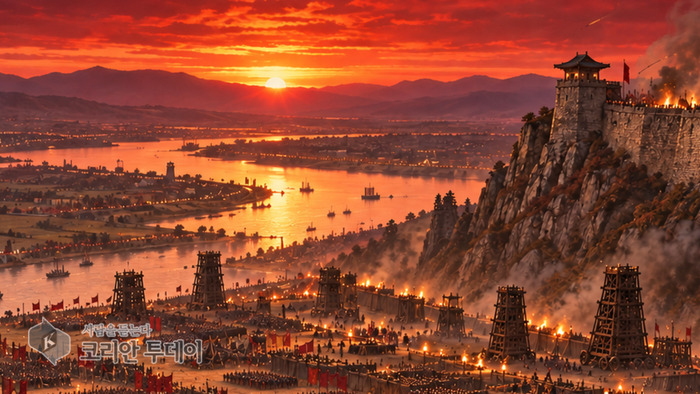
“The war drums on the walls had long fallen silent. After more than a month of siege the granaries were empty, and the defenders looked down on a sea of Tang and Silla banners, like the last holdouts of a Roman fortress waiting for a relief army that would never come.”
“(Reconstruction) Then the gate opened. Namgeon wanted to fight on, but the Samguk Sagi says a monk, Sinseong, who commanded the gate had already made terms with the enemy. King Bojang bowed in surrender, and Pyongyang’s old sky went dark.”
◆ Uncovering Historical Truth
Pyongyang fell in the ninth lunar month of 668, which converts to late October in the Gregorian calendar, so sources quote different dates. Supreme commander was Li Ji (Li Shiji), a veteran who had served Tang since its founding. Silla’s King Munmu directed support from Hansan, with generals such as Kim Inmun in the field. The aged Kim Yushin, often imagined at the walls, stayed home in Silla’s capital. Like a Roman consul, a Tang general such as Li Ji held command over a multinational army, with allied contingents attached to his central force.
The Samguk Sagi describes Goguryeo as a state of five regions and 176 fortresses with about 700,000 households, a scale comparable to a mid-sized Roman province. Its fall owed less to battlefield defeat than to a succession crisis after Gaesomun’s death, plus exhaustion, the collapse of the Liaodong line, and Namsaeng’s defection. Archaeology of the mountain-fortress system shows defenses overcome one after another by concentrated assaults.
Tang then planned to divide Goguryeo into nine commanderies under a protectorate at Pyongyang, a structure resembling Roman provincial administration. King Bojang and tens of thousands of nobles and subjects were deported to China. For Silla this meant the elimination of its northern rival, but Tang soon tried to treat Silla itself as a subordinate, turning the alliance into the Silla-Tang War (the next episode). Unification was decided over the following years, not in 668.
Period
668 CE (late 7th century)
Key Figures
King Munmu, Li Ji, Yeon Namsaeng, King Bojang
Scale
About 700,000 households, 176 fortresses (per Samguk Sagi)
Military
Siege warfare against mountain fortresses, combined Tang-Silla armies
🔍 International Academic Perspectives
Korean/Asian Scholars
Many Korean historians call 668 the turning point of unification, but an incomplete one, since Silla held only the area south of the Taedong River to Wonsan Bay. Some prefer the term “North-South States Period,” including Balhae, over “unification.”
Western Historians
English-language scholarship generally treats this as a Tang strategic victory in which Silla was a junior partner, and stresses that Silla’s real achievement was expelling Tang from the peninsula afterward. Chinese scholarship emphasizes Tang administration of former Goguryeo lands.
📖 Key Terms Explained
- Goguryeo (高句麗)
- Northern Korean kingdom (traditionally 37 BCE – 668 CE), the model for the name “Korea” (via Goryeo).
- Daemangniji (大莫離支)
- Goguryeo’s highest office, held by Yeon Gaesomun; roughly comparable to a Frankish mayor of the palace or a Japanese shogun in real power.
- Protectorate General to Pacify the East (安東都護府)
- Tang’s frontier administration in former Goguryeo territory, set up in 668 and later forced out of the peninsula.
◆ Lessons for Today’s World
Like Germany’s 1871 unification, which left Austria out, or Italy’s Risorgimento that still left a long divide between north and south, Silla’s 668 victory united the state before it united the people. Alliances bring opportunity and a price: Tang helped Silla destroy its rivals and then tried to rule the peninsula.
For today’s Korea, divided since 1945, the lesson is that unification is a long process of reconciling different societies, not a single event. The lessons about internal division and about the cost of dependence on a great-power partner echo debates around NATO and the EU: a security umbrella is valuable, but autonomy must be earned.
| Aspect | Silla Era | Modern Parallel |
|---|---|---|
| Geopolitics | Three kingdoms compete, then merge by conquest | Divided peninsula amid US-China-Russia dynamics |
| Military | Fortress defense collapses under coalition siege | Alliance-based deterrence |
| Culture | Absorbing Goguryeo refugees and Buddhist-Confucian learning | K-Culture as a shared global identity |
[Image: From ancient kingdom to modern Korea’s debate over unification]
📚 Diving Deeper
- Goguryeo tombs and murals at Pyongyang and Jian are UNESCO World Heritage sites, and Gyeongju’s Historic Areas (Silla’s capital) are in South Korea.
- The epitaph of Yeon Namsaeng, unearthed at Luoyang in China, is an epigraphic source rivaling the Sutton Hoo finds for how directly it speaks about a fallen elite.
- Further reading: the Samguk Sagi and Samguk Yusa, and the relevant chapters of The Cambridge History of China (Sui and T’ang China) and Korean history surveys by Lee Ki-baik and Mark Byington.
The Voice of Living History
Powerful states fall when they split from within, and victors are judged by what they build afterward. 668 was not an ending, but the opening of a harder question.
“The gates of Pyongyang closed, but the people’s story flowed south and built something new.”
Previous Episode
Episode 15: Conquest of Baekje, the Victory of 660
Next Episode
Episode 17: The Silla-Tang War, Toward True Unification
The Korean Today “History Lives On” Series
The Silla Chronicle (35 Episodes)
Bridging Ancient East Asia and the Modern World
© 2025 The Korean Today. All rights reserved.
This content is based on historical facts and presents balanced academic perspectives
for international readers.
<저작권자 ⓒ 코리안투데이(The Korean Today) 무단전재 및 재배포 금지>